

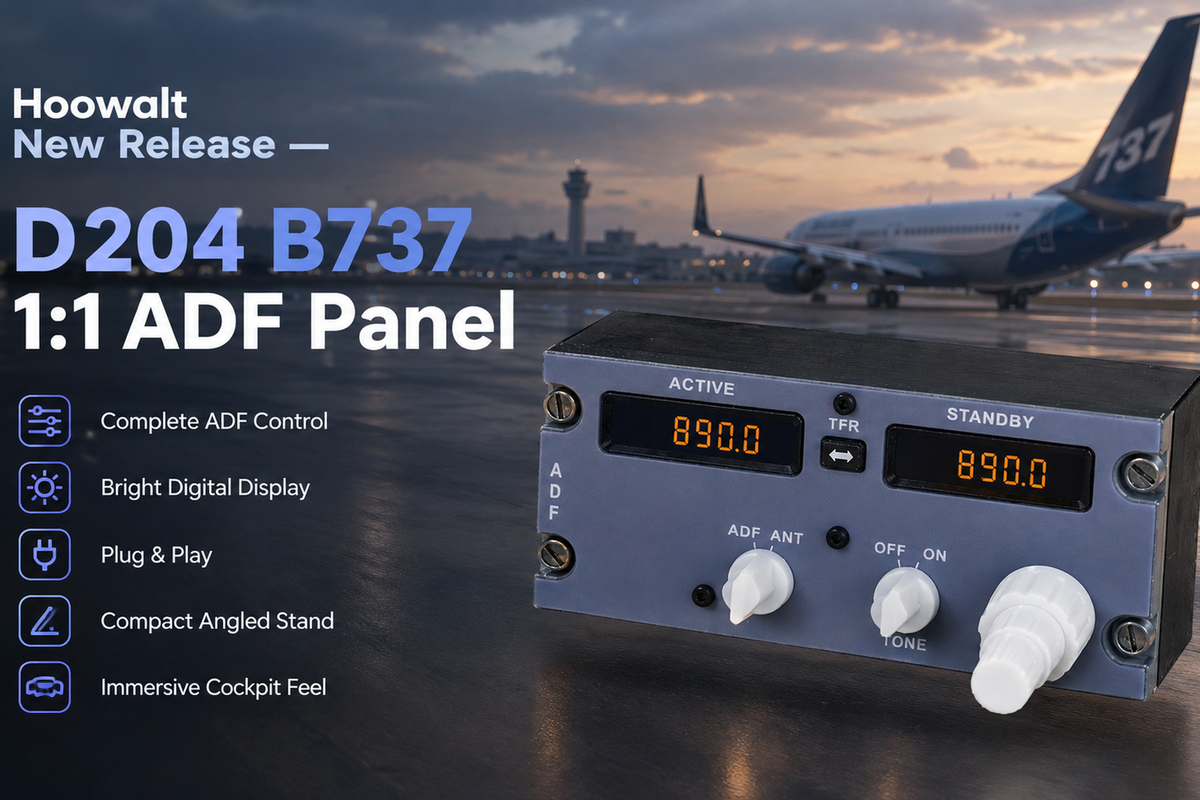
In a typical flight simulation cockpit, certain instruments tend to receive less attention than others. The ADF — Automatic Direction Finder — is one of them. It is not as visually prominent as the PFD or ND, and its function is often secondary to GPS or VOR navigation in modern operations. Yet for pilots flying older aircraft, or for those who prefer traditional radio navigation, the ADF remains a useful and sometimes necessary tool.
The Hoowalt D204 is a dedicated USB control panel designed specifically for ADF operation in B737 simulations. It provides physical controls and a clear digital display, allowing users to interact with the ADF system without reaching for the mouse.
Control Layout and Operation
The panel is laid out to mirror the ADF control section found in the B737 cockpit. It includes several functional controls:
-
TFR button – transfers the active and standby frequencies
-
ADF/ANT selector – switches between ADF and ANT (antenna) modes
-
TONE knob – two-position toggle (OFF/ON) for audio tone monitoring
-
Dual-layer adjustment knob – allows independent tuning of frequency digits
This arrangement replicates the workflow of the real ADF panel. Users can tune frequencies directly, switch modes, and monitor audio feedback — all from a dedicated hardware interface rather than a virtual cockpit overlay.
The unit also features a bright digital display that shows the selected frequency clearly, making it readable even in varied lighting conditions.

Compatibility and Integration
The D204 is compatible with:
-
MSFS 2020 / MSFS 2024
-
X-Plane 12
-
ZIBO 737 and PMDG 737 on Windows
Setup is handled through MobiFlight, which allows for flexible axis and button mapping. This is the same configuration software used across Hoowalt's B737 panel series, making it consistent for users who already own other panels in the lineup.
Desktop-Friendly Design
The D204 is built with a compact angled stand that provides a comfortable viewing angle when placed on a desk or integrated into a cockpit frame. Its dimensions — 14.5 × 8 × 6.5 cm — occupy minimal space, allowing it to sit alongside other controls without crowding the workspace.
The angled design also facilitates operation, as the panel face is tilted toward the user, reducing the need to lean forward during use.

Construction and Materials
The panel body is made from ABS, a material commonly used in consumer electronics for its balance of durability and ease of finishing. Weight is 250g, which provides stability without being overly heavy.
The printed markings and labels are designed to match the color scheme and typography of the B737 cockpit. While the D204 is a compact desktop peripheral, its visual design is consistent with the instrument panel aesthetic.
Packaging and Specification Summary
| Item | Detail |
|---|---|
| Material | ABS |
| Product Weight | 250g |
| Package Weight | 800g |
| Product Dimensions | 14.5 × 8 × 6.5 cm |
| Package Dimensions | 20.5 × 11 × 14 cm |
| Packing | Graphic Carton |
| Recommended Age | 16+ |

Integration with Hoowalt D201 and D203
The D204 is designed to function as a standalone unit, but it also forms part of a larger B737 radio/navigation control ecosystem when paired with Hoowalt's other panels — specifically the D201 Radio Tuning Panel and the D203 Transponder Panel.
When combined, these three units cover the majority of radio, navigation, and transponder functions found on the B737 pedestal and lower center console. For users building a more complete desktop cockpit, the D204 adds a piece that is often overlooked in generic setups.
Final Remarks
The D204 is not a high-frequency control in the sense that it will be used on every flight. Its utility depends on the user's preferred navigation methods and aircraft choices. For those who fly the ZIBO or PMDG 737 and wish to operate the ADF through physical hardware rather than clicking on-screen, it provides a practical solution.
As with other Hoowalt panels, the D204 is handmade and assembled to order, with production lead times longer than mass-produced consumer electronics. Users who appreciate dedicated control surfaces for specific cockpit functions may find it a useful addition to their simulation environment.
🔗Link:https://hoowalt.com/products/hoowalt-d204-b737-1-1-adf-automatic-direction-finder-panel


